
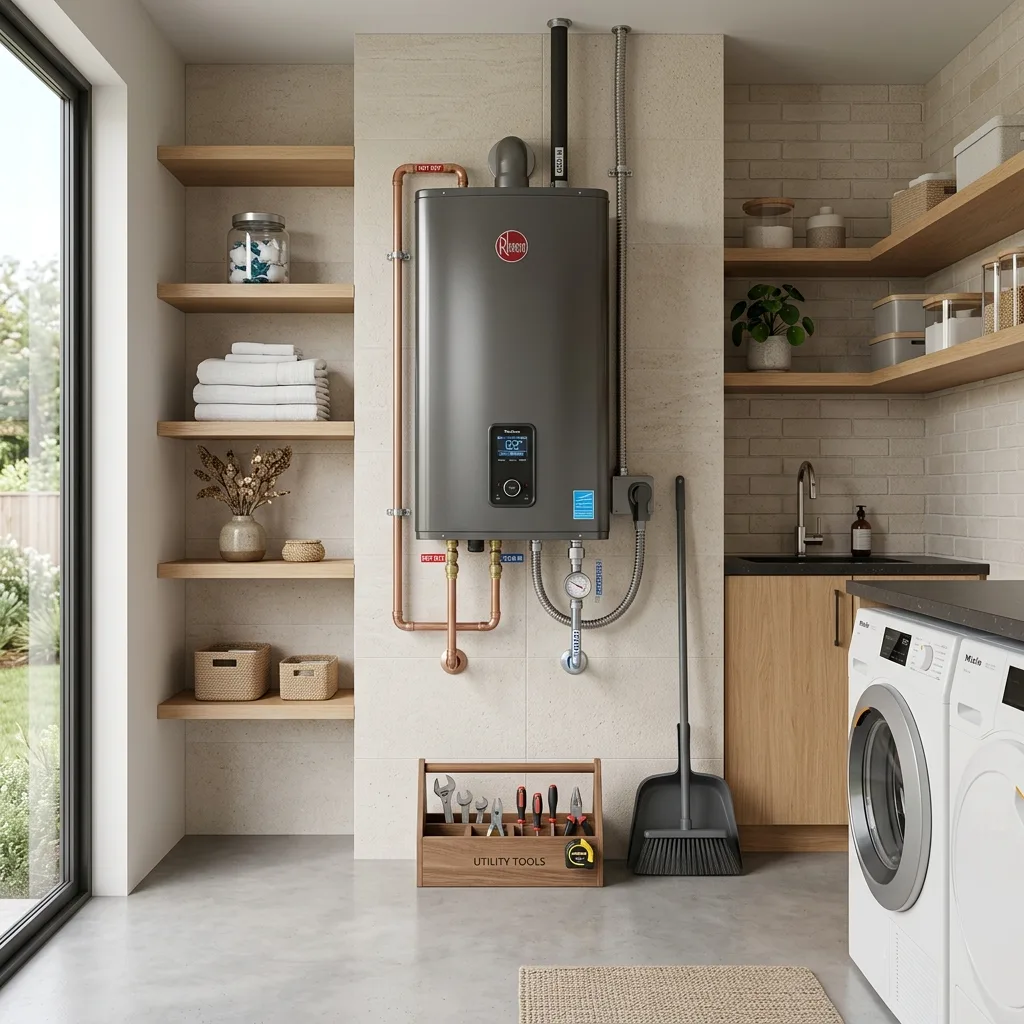
As the global push toward home electrification accelerates in 2025 and 2026, one piece of technology has emerged as the clear winner for both energy savings and environmental impact: the heat pump water heater (HPWH). Often described as a “reverse air conditioner,” this revolutionary appliance is transforming how we think about one of the most energy-intensive processes in the modern home. In this exhaustive guide, we will break down the physics, the finances, and the future of hot water.
Table of Contents
- ●Quick Summary: Why Switch to HPWH?
- ●1. The Science of Moving Heat: How It Works
- ●2. Efficiency Comparison: The Numbers Don’t Lie
- ●3. The Financial Incentive: 2026 Tax Credits and Rebates
- ●Pro Tip: Check Your Utility Portal
- ●4. Installation 101: Space, Air, and Power
- ●5. Understanding the Modes: How to Optimize Your Savings
- ●6. Climate Considerations: Cold vs. Warm Performance
- ●7. The “Thermal Battery” Concept: Integrating with Solar
- ●8. Maintenance: How to Make Your Unit Last 20 Years
- ●9. The Future: 120V “Plug-In” Models
- ●Frequently Asked Questions
- ●Is a heat pump water heater noisy?
- ●Will it make my basement freezing cold?
- ●Can I install it myself?
- ●What is the lifespan of a HPWH?
- ●Conclusion: The Ultimate Green Home Upgrade
- ●Stop Wasting Energy Today
Quick Summary: Why Switch to HPWH?
- Unmatched Efficiency: HPWHs are 3 to 4 times more efficient than standard electric water heaters.
- Massive Tax Credits: Claim up to $2,000 back through the Inflation Reduction Act (IRA) 25C tax credit.
- Dehumidification Bonus: These units naturally dehumidify and cool the surrounding space (perfect for basements).
- Rapid Payback: Most households see a full return on investment in just 2 to 4 years.
1. The Science of Moving Heat: How It Works
To understand why heat pump water heaters are so revolutionary, we first have to understand the difference between generating heat and moving it. Conventional water heaters—whether gas or electric resistance—must create heat. This is an energy-intensive process where 1 unit of energy (electricity or gas) yields, at best, slightly less than 1 unit of heat. This is known as “thermal efficiency,” and it has a hard cap of 100%.
A heat pump, however, doesn’t create heat. Instead, it uses a refrigerant cycle to extract heat from the surrounding air and “pump” it into the water tank. This is exactly how your refrigerator or air conditioner works, but in reverse. Because it is only moving existing thermal energy, a heat pump can achieve a Coefficient of Performance (COP) of 3.5 to 4.2. In simple terms, for every 1 unit of electricity you put in, you get 4 units of heat out. This is 400% efficiency, a feat that was once considered impossible for home appliances.

2. Efficiency Comparison: The Numbers Don’t Lie
When we look at the numbers for 2026, the gap between old-school technology and modern heat pumps is staggering. A typical 4-person household using a standard electric water heater will spend between $600 and $800 annually just on hot water. Switching to a heat pump model can slash that bill to under $180 per year. Over the 15-year lifespan of the unit, that is a direct saving of nearly $9,000.
| Water Heater Type | Typical Efficiency | Annual Operating Cost | 15-Year Total |
|---|---|---|---|
| Heat Pump (Hybrid) | 350% – 420% | $160 – $210 | $2,700 |
| Natural Gas (Standard) | 60% – 65% | $350 – $450 | $6,000 |
| Electric Resistance | 95% – 98% | $650 – $850 | $11,250 |
| Propane/Oil | 60% – 85% | $800 – $1,200 | $15,000+ |
3. The Financial Incentive: 2026 Tax Credits and Rebates
In addition to the monthly energy savings, the upfront cost of heat pump water heaters is being heavily subsidized by government initiatives. The **Inflation Reduction Act (IRA)** introduced the 25C Energy Efficient Home Improvement Credit. Specifically, for any heat pump water heater installed through 2032, you are eligible for a tax credit of 30% of the total project cost, capped at $2,000 per year.
Wait, there’s more. Many states (like California, New York, and Maine) offer local utility rebates that can range from $500 to $1,500. In some specific cases, the combination of federal tax credits and local rebates can bring the net cost of a $2,500 unit down to nearly zero. Consequently, 2026 is mathematically the best time to replace an aging water heater, even if it hasn’t failed yet.
Pro Tip: Check Your Utility Portal
Before you buy, log in to your local electric utility’s website. Search for “HPWH Rebate.” Many utilities offer “Instant Rebates” where the discount is applied directly at the point of sale, meaning you don’t even have to wait for a check in the mail.
4. Installation 101: Space, Air, and Power
Installing a heat pump water heater is slightly different from a standard tank. Because it pulls heat from the air, it needs air to breathe. Most manufacturers require at least 450 to 700 cubic feet of unconfined space. This makes a standard 10′ x 10′ utility room or a garage an ideal location. If you must install it in a small closet, you will need to use louvered doors or a ducting kit to ensure proper airflow.
Furthermore, you need to manage the “condensate.” Just like an air conditioner, a heat pump pulls moisture out of the air. This moisture turns into water that must be drained away. Most installers simply run a small 3/4″ pipe to a nearby floor drain or use a small condensate pump to send the water outside. Additionally, while older HPWHs required a 240V dedicated circuit, new “Plug-In” 120V models are hitting the market in late 2025, making them a “drop-in” replacement for gas units without needing an electrician.
5. Understanding the Modes: How to Optimize Your Savings
Modern HPWHs are incredibly versatile. Most units come with 4 distinct operating modes that you can control via a smartphone app. Understanding these is key to maximizing your comfort and your wallet:
- Heat Pump Only Mode: The most efficient setting. It uses only the heat pump and never the backup heating elements. This is ideal for 1-2 person households or those with very large tanks.
- Hybrid/Eco Mode: The default and most popular setting. It uses the heat pump for 90% of the work but will activate the electric resistance elements if you have a massive hot water demand (like filling a large soaking tub).
- High Demand Mode: Prioritizes recovery speed over efficiency. Great for when guests are staying over and everyone is taking back-to-back showers.
- Vacation Mode: Drops the temperature to 50°F (10°C) and waits for your return, saving hundreds of kilowatt-hours while you’re away.
6. Climate Considerations: Cold vs. Warm Performance
A common question I get is: “Do they work in the winter?” The answer is a resounding yes, but with some caveats. In warmer climates like Florida or Arizona, a heat pump water heater is a dream machine. It takes the hot garage air, cools it down, dries it out, and gives you free hot water. It’s essentially a free air conditioner for your garage.
In colder climates like Maine or Minnesota, the unit will still work perfectly inside a basement. Basements stay relatively stable at 50°F to 60°F year-round. While the heat pump’s efficiency drops slightly as the air gets colder, it still remains significantly more efficient than any other electric option. Moreover, the dehumidification benefit prevents basement mold, which is a massive hidden value for northern homeowners.
7. The “Thermal Battery” Concept: Integrating with Solar
In the 2026 smart home, your water heater is no longer just a tank; it’s a battery. If you have solar panels, you can program your HPWH to “overheat” the water during the middle of the day when your panels are producing excess energy. By raising the tank temperature to 140°F during the day and using a mixing valve to bring it back down to 120°F at the tap, you are effectively storing solar energy as heat.
This allows you to avoid using expensive grid electricity at night. Furthermore, many utilities are now paying homeowners to let them remotely “throttle” their water heaters during peak grid stress. These “Demand Response” programs can net you an additional $50 to $100 per year in credits. Therefore, your heat pump water heater is an active participant in the green energy grid.
8. Maintenance: How to Make Your Unit Last 20 Years
Like any high-performance machine, a little maintenance goes a long way. Fortunately, heat pump water heaters are remarkably low-maintenance. There are three main tasks you should perform:
- Clean the Air Filter: Most units have a washable plastic mesh filter at the top. Check it every 3-6 months. If it’s clogged with dust, the unit has to work harder, which drops your efficiency. Simply rinse it in the sink and slide it back in.
- Check the Anode Rod: This is a sacrificial metal rod that prevents the tank from rusting. In areas with hard water, check it every 3 years. Replacing a $30 rod can add 10 years to your tank’s life.
- Flush the Tank: Once a year, connect a garden hose to the bottom drain valve and flush out any sediment. This is especially important if you have a well or high mineral content in your water.
9. The Future: 120V “Plug-In” Models
The biggest barrier to heat pump water heater adoption has historically been the electrical upgrade. Swapping a gas water heater for an electric one usually required running a new 240V wire from the main panel, which could cost $1,000 or more. However, the 2026 market is being flooded with 120V “shared-circuit” models. These units use a standard household plug and a tiny amount of power, often less than a hairdryer.
While these units have a slower “recovery” rate, they are perfect for households of 1 to 3 people. By eliminating the need for an electrician, the total cost of installation drops by 40%. Consequently, we expect the 120V plug-in market to become the dominant choice for retrofitting older homes over the next two years.
Frequently Asked Questions
Is a heat pump water heater noisy?
Specifically, most modern units produce about 45 to 55 decibels of sound—roughly the same as a quiet dishwasher. You will hear a hum when the fan is running, but it is rarely noticeable if the unit is in a garage, basement, or utility room. Furthermore, many apps allow you to schedule “quiet hours.”
Will it make my basement freezing cold?
No. While the unit does exhaust cool air, the volume is not enough to drastically change the temperature of a standard-sized basement. You might notice a 1-2 degree drop in the immediate vicinity of the unit. However, the dehumidification benefit usually makes the room feel much more comfortable anyway.
Can I install it myself?
If you are comfortable with basic plumbing (connecting pipes) and, in the case of 120V models, simply plugging it in, then a DIY installation is possible. However, 240V models require electrical expertise. Specifically, we always recommend hiring a licensed pro to ensure the condensate drain and temperature-pressure relief valves are installed to code.
What is the lifespan of a HPWH?
Most heat pump water heaters are built to last 13 to 15 years. With proper maintenance (anode rod replacement and flushing), many units are reaching the 20-year mark. This is comparable to, and often better than, the lifespan of standard gas or electric tank units.
Conclusion: The Ultimate Green Home Upgrade
In conclusion, the heat pump water heater is no longer a niche technology for early adopters. In 2026, it is the most logical, financially sound, and environmentally responsible choice for any homeowner. By moving heat rather than creating it, you are leveraging the laws of physics to save thousands of dollars and significantly reduce your carbon footprint.
Whether you are motivated by the $2,000 tax credit, the $50 monthly bill reduction, or the desire to move away from fossil fuels, the HPWH delivers on all fronts. Specifically, I encourage you to start by auditing your current energy bills and looking up local rebates. The future of home efficiency is here, and it’s huming quietly in your utility room.
Stop Wasting Energy Today
Upgrade to a heat pump water heater and join the thousands of Eco-Dwellers saving money and the planet.
Calculate Your Savings
Written by Mangaleswaran
Mangaleswaran is a dedicated sustainable living expert and the founder of EcoDweller. With a deep passion for renewable energy, he specializes in simplifying complex green technologies—like solar power and home efficiency—for the modern homeowner. His mission is to empower individuals to reduce their environmental impact while building more cost-effective, eco-friendly homes for the future.
Follow on Facebook