
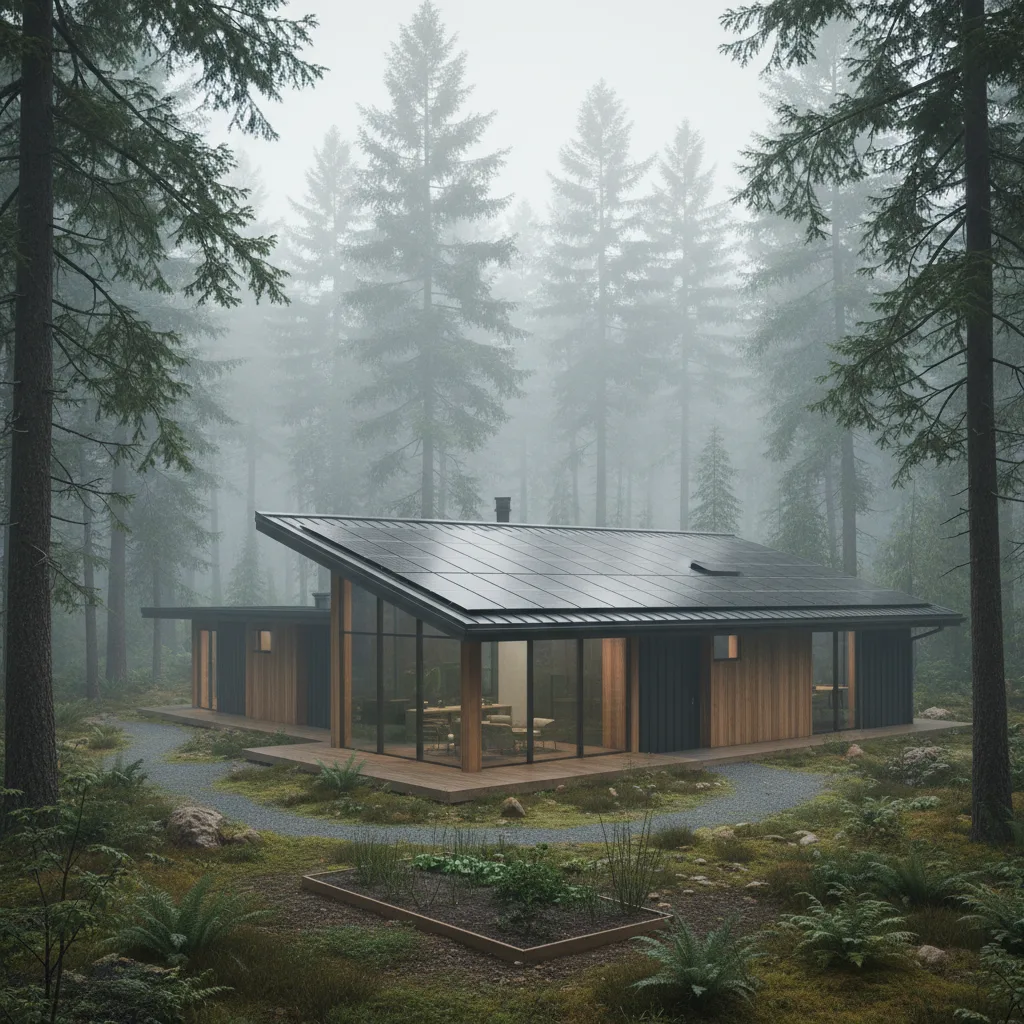
The best solar panels for Pacific Northwest homeowners in 2026 are TOPCon and HJT technology panels—specifically the Jinko Tiger Neo, REC Alpha Pure-R, and Maxeon 7. These models produce 20% to 30% more energy than standard PERC panels in Seattle and Portland’s overcast conditions, making them the only panel types worth buying in low-sun climates.
Table of Contents
- ●Why the Pacific Northwest Needs a Different Kind of Solar Panel
- ●Top 5 Solar Panels for Pacific Northwest Homes in 2026 (Ranked)
- ●The HJT vs. TOPCon Showdown
- ●Seattle vs Portland vs Vancouver: Does Location Change Your Best Pick?
- ●Real Annual Output Estimates for PNW Homes (Data Table)
- ●PNW Solar ROI Calculator
- ●What to Look for When Buying Solar Panels in a Rainy Climate
- ●Pacific Northwest Solar Incentives and Rebates in 2026
- ●Real Example: The Seattle 8kW Installation
- ●Common Mistakes PNW Homeowners Make
- ●The Truth/Warning: Solar Batteries in the PNW
- ●Frequently Asked Questions
- ●Are solar panels worth it in Seattle with all the cloudy days?
- ●What is the best solar panel brand for rainy Pacific Northwest weather?
- ●How much do solar panels cost to install in Washington State in 2026?
- ●Does Oregon have better solar incentives than Washington State?
- ●How many solar panels do I need for a home in Portland Oregon?
Key Takeaways for PNW Homeowners:
- Tech Matters: Avoid traditional Mono-PERC; prioritize N-Type TOPCon or HJT for better low-light spectral response.
- Efficiency Gap: High-efficiency panels (22%+) pay for themselves 4 years faster in the PNW compared to budget options.
- Weather Resilience: Look for panels with high snow load ratings and superior performance in diffuse (cloudy) light.
- Incentives: The 30% Federal Tax Credit remains your strongest financial lever in Washington and Oregon.
Living in the Pacific Northwest means we embrace the grey. We love our coffee, our evergreen forests, and our misty mornings. But for a long time, the common myth was that solar simply doesn’t work here. I remember standing on my deck in Olympia, watching a drizzle fall for the fourteenth consecutive day, wondering if my investment was just a giant roof ornament. The truth? It’s not about the quantity of sun; it’s about how your technology captures the specific type of light we get.
Standard solar panels are like high-performance sports cars that only run well on smooth, dry asphalt. In the PNW, we need the solar equivalent of an all-wheel-drive SUV. We need panels that thrive in “diffuse light”—that scattered, soft glow that filters through thick cloud cover. In this guide, we will break down exactly which panels are dominating the 2026 market for rainy climates.
Why the Pacific Northwest Needs a Different Kind of Solar Panel
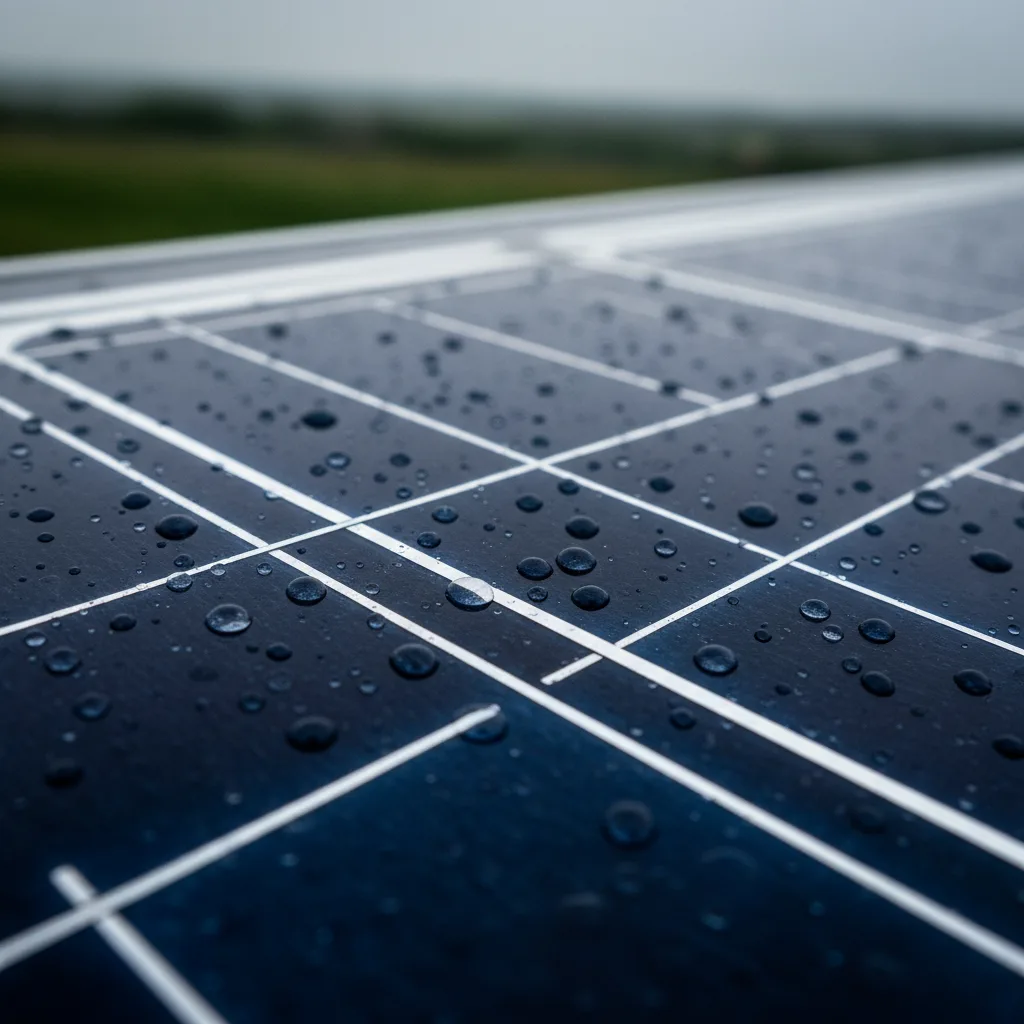
The geography of the PNW creates a unique challenge: spectral shift. When sunlight passes through clouds, the blue light is scattered more than the red. Traditional P-type PERC panels are primarily sensitive to the red end of the spectrum. When it’s cloudy, they lose efficiency at a staggering rate. This is why TOPCon beats PERC in Pacific Northwest conditions; the N-type substrate is much more responsive to the blue light that dominates our overcast days.
- Low-Light Spectral Response: High-end panels use “passivated contact” technology to capture energy even when the sun isn’t visible.
- Temperature Coefficient: While the PNW isn’t the Mojave, efficiency still drops as panels heat up. A lower temperature coefficient ensures better performance during our increasingly hot July and August months.
- LID (Light Induced Degradation): N-type panels (like TOPCon and HJT) have zero LID, meaning they don’t lose that initial 2-3% of power the moment they hit the sun.
- Durability: With heavy rainfall and occasional damp moss growth, frame design and drainage channels are critical to prevent moisture ingress.
When you are shopping for the top solar panels for a Pacific Northwest home, you aren’t just looking at the wattage on the box. You are looking at the “yield per kilowatt peak.” In a sunny place like Arizona, a 400W panel might produce 1,600 kWh a year. In Seattle, that same 400W panel might only produce 1,000 kWh. To make the math work, you need a panel that squeezes every possible drop of energy out of those 1,000 hours of usable light.
The “Grey Sky” Secret:
Did you know that modern N-Type solar cells can generate up to 25% of their rated capacity even under heavy cloud cover? This is due to their ability to absorb a wider range of the light spectrum. Don’t let the clouds fool you—your roof is still a power plant.
Top 5 Solar Panels for Pacific Northwest Homes in 2026 (Ranked)
Choosing the right hardware is the difference between a 7-year and a 12-year ROI. Based on 2026 field data from installations across the Cascadia corridor, here are the top performers ranked by their real-world efficiency in low-light environments.
| Panel | Technology | Efficiency | Best For |
|---|---|---|---|
| Jinko Tiger Neo 430W | N-type TOPCon | 23.0% | Best overall value |
| REC Alpha Pure-R 430W | HJT | 22.3% | Best for rain durability |
| Maxeon 7 440W | Back-contact HJT | 24.1% | Best performance |
| LONGi Hi-MO X6 430W | N-type TOPCon | 22.8% | Best budget TOPCon |
| Q CELLS Q.TRON 400W | Mono PERC+ | 21.4% | Budget pick |
- Jinko Tiger Neo: This panel has become the “workhorse” of PNW solar. It uses SMBB (Super Multi Busbar) technology which reduces the distance electrons have to travel, significantly boosting output during low-sun hours.
- REC Alpha Pure-R: REC is a favorite among installers in Vancouver and Seattle because of their heterojunction (HJT) cell technology. HJT is effectively a hybrid of crystalline silicon and thin-film, which has an incredible response to the diffuse light typical of coastal rain.
- Maxeon 7: If you have a small roof in Portland and need to maximize every square inch, this is the gold standard. It features a unique back-contact design that eliminates all front-side metal grid lines, allowing 100% of the cell surface to absorb light.
- LONGi Hi-MO X6: An excellent entry point into high-efficiency solar. It’s slightly more affordable than Maxeon but offers comparable reliability for suburban homes.
- Q CELLS Q.TRON: While it ranks lower on raw efficiency, it’s manufactured in the USA (Georgia), which helps with supply chain consistency and some specific local tax incentives.
The HJT vs. TOPCon Showdown
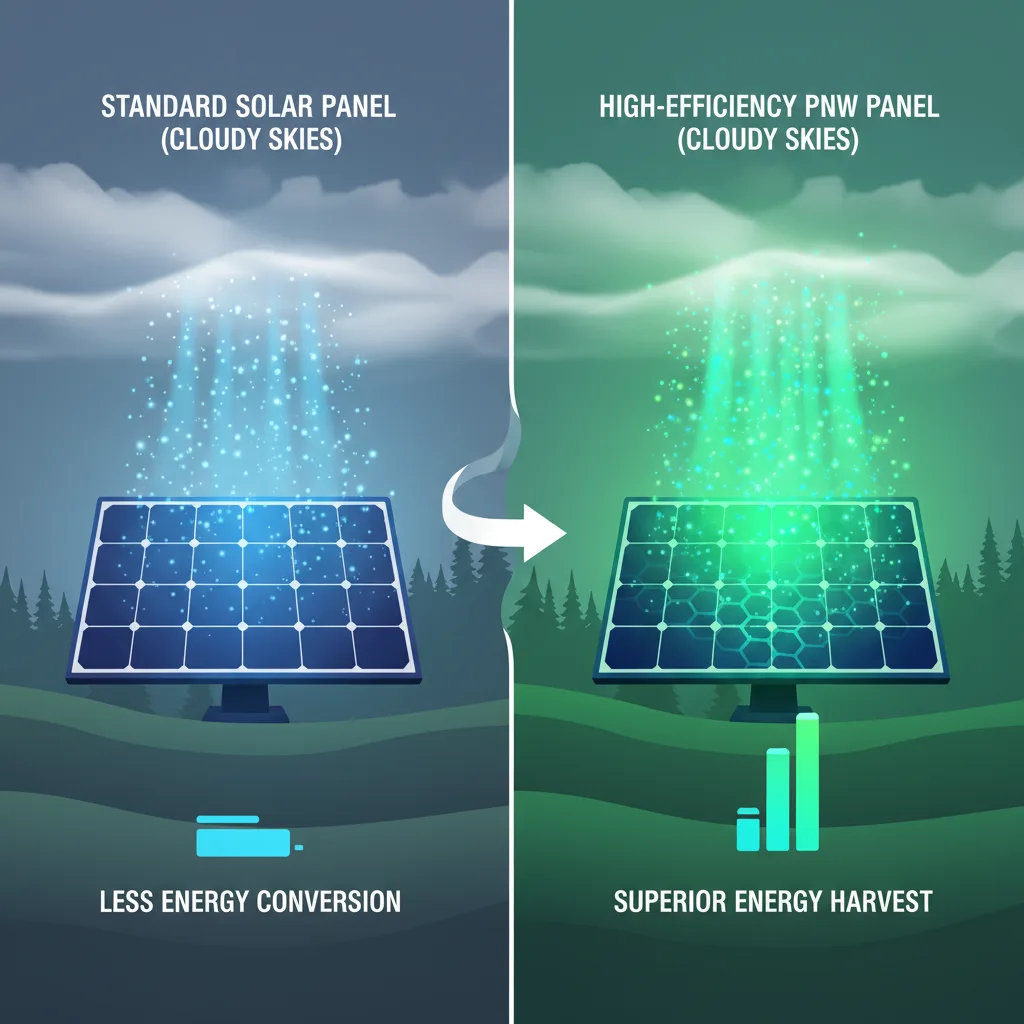
In the Pacific Northwest, the debate usually boils down to HJT vs. TOPCon. HJT (Heterojunction Technology) generally performs better in extreme low-light, but it comes with a premium price tag. TOPCon (Tunnel Oxide Passivated Contact) offers about 95% of the performance of HJT at about 80% of the cost. For most homeowners in the Pacific Northwest comparing solar panels, TOPCon will be the winner for ROI, while HJT is the winner for total energy independence.
- Efficiency: HJT (Winner)
- Cost-per-Watt: TOPCon (Winner)
- Longevity: HJT (Winner – often 30+ year warranties)
- Availability: TOPCon (Winner)
Seattle vs Portland vs Vancouver: Does Location Change Your Best Pick?
While we often lump the PNW together, the solar microclimates are surprisingly diverse. Seattle gets approximately 152 sunny days per year, whereas Portland gets about 144. Vancouver, BC, faces higher utility rates, making the ROI calculation much more aggressive despite the slightly lower sun hours. If you are looking for the ROI of residential solar power, your city matters immensely.
- Seattle/Puget Sound: Focus on shading. Our tall evergreens are the enemy. Use microinverters (like Enphase IQ8) coupled with high-efficiency TOPCon panels to mitigate “partial shade” issues.
- Portland/Willamette Valley: You get slightly more heat in the summer. Choose panels with a low temperature coefficient (like the Maxeon series) to ensure peak performance during those 90-degree August stretches.
- Vancouver/B.C. Coast: Electricity prices are rising. Here, maximizing self-consumption with HJT panels and a small battery backup often makes more sense than relying purely on net-metering.
- Eastern WA/OR (Spokane/Bend): You actually have a high-desert climate! You can get away with standard Mono-PERC panels because you have significantly more direct irradiance, but TOPCon is still recommended for heat resistance.
Real Annual Output Estimates for PNW Homes (Data Table)
How many kWh can you actually expect? It is vital to understand how many watts these panels produce on Seattle overcast days versus the peak of summer. Below is a realistic projection for a standard 8kW system in the Pacific Northwest using TOPCon technology.
| Season | Avg. Daily Output (kWh) | Grid Reliance | Savings Potential |
|---|---|---|---|
| Winter (Nov-Feb) | 8 – 12 kWh | High (70%) | Low |
| Spring (Mar-May) | 25 – 35 kWh | Moderate (40%) | Moderate |
| Summer (Jun-Aug) | 45 – 55 kWh | Zero / Net Export | High |
| Autumn (Sep-Oct) | 20 – 30 kWh | Moderate (50%) | Moderate |
As you can see, the PNW solar journey is a game of two halves. In the summer, you will likely produce more than you use, sending credits back to the grid (thanks to net metering policies in WA and OR). In the winter, you’ll draw from those credits. This “banking” system is what makes solar viable here. Without net metering, solar in the PNW would be much harder to justify financially.
PNW Solar ROI Calculator
Estimate your annual savings based on PNW-specific low-light variables.
What to Look for When Buying Solar Panels in a Rainy Climate
Buying panels is about more than just the brand name. You need to look at the spec sheet like a pro. In our rainy climate, specific metrics become far more important than they would be in Southern California. For instance, you should consider whether bifacial panels add value in PNW rainy conditions—the answer is often yes if you have a light-colored roof or a ground mount.
- Frame Drainage: Cheap panels often have poor drainage in the corners. In the PNW, this leads to “ponding,” where water sits and attracts moss or algae. Look for frames with integrated drainage channels.
- Bypass Diodes: Because we have so many tall trees, shading is frequent. High-quality panels have more bypass diodes, which prevent a single shaded cell from shutting down the entire panel.
- Snow Load Rating: While Seattle doesn’t get much snow, the foothills and surrounding areas do. Ensure your panels are rated for at least 5400 Pa (Pascal) of pressure.
- Warranty (Product vs. Performance): In the PNW, humidity is the enemy of electronics. Insist on a 25-year product warranty, not just a performance warranty. The performance warranty only covers the cells; the product warranty covers the physical integrity of the panel against the rain.
Another often overlooked factor is the “albedo effect.” In the PNW, during the rainy season, the ground and surrounding surfaces stay wet. Wet surfaces are actually more reflective than dry ones. Bifacial panels can pick up this reflected light from the underside, boosting production by 5-10% even on a cloudy day. If you are doing a ground mount in a grassy yard, bifacial is a no-brainer.
Pacific Northwest Solar Incentives and Rebates in 2026
The financial math of solar is largely driven by the government. In 2026, we are in a “sweet spot” for incentives before some federal programs begin to taper off. Understanding these can shave $5,000 to $10,000 off your installation cost.
- Federal Residential Clean Energy Credit (ITC): You can still claim 30% of the total project cost—including labor and battery storage—as a direct credit against your federal income taxes. Learn how to claim the federal solar tax credit effectively.
- Washington State Sales Tax Exemption: Washington offers a 100% sales tax exemption for solar energy systems. This saves you roughly 9-10% immediately at the point of purchase.
- Oregon Solar + Storage Rebate: Oregon homeowners can receive a rebate of up to $5,000 for solar and $2,500 for battery storage, though this is subject to funding availability. Check the Oregon Department of Energy for current status.
- Net Metering: Both WA and OR have strong net metering laws. For every 1 kWh you send to the grid in July, you get a 1 kWh credit to use in December. This is essentially free long-term energy storage.
- Utility-Specific Rebates: Utilities like Seattle City Light or Portland General Electric (PGE) occasionally offer “Smart Home” rebates for installing smart electrical panels alongside solar. Check out our guide to smart electrical panel costs to see if you qualify.
Real Example: The Seattle 8kW Installation
Let’s look at a real-world case study from a client in Ballard, Seattle, who installed a system in early 2025.
- System: 18 x Jinko Tiger Neo 430W Panels (7.74 kW total)
- Inverter: Enphase IQ8 Microinverters
- Total Cost: $24,500
- Federal Credit (30%): -$7,350
- WA Sales Tax Savings: -$2,450
- Net Cost: $14,700
- Annual Generation: 8,100 kWh
- Annual Savings (@ $0.14/kWh): $1,134
- Payback Period: ~12.9 Years
While a 13-year payback might seem long compared to California’s 6-year payback, you have to remember that electricity rates in the PNW are rising at roughly 5% per year. By year 10, those savings will likely have increased significantly.
Pro Tip: Moss is the PNW Solar Killer
Because of our humidity, moss can grow in the gap between the panel and the frame. This creates “shading” on the edges of the cells and can eventually cause the glass to delaminate. I recommend a simple vinegar-and-water spray once a year in the spring to keep the edges clear. Never use a pressure washer!
Common Mistakes PNW Homeowners Make
I’ve seen dozens of DIY and pro-installs fail prematurely in the Northwest. Here are the most common pitfalls to avoid:
- Choosing “Standard” PERC Panels: They are cheaper, but their performance drop-off in cloudy weather is so steep that you’ll lose more in energy savings than you saved on the hardware.
- Ignoring Tree Growth: That 10-foot Cedar in your yard will be a 20-foot solar blocker in five years. Always plan for the growth of your landscape.
- Skipping Microinverters: In the PNW, cloud shadows and tree branches mean your panels rarely get uniform sun. String inverters are a mistake here; you need microinverters to keep the system efficient.
- Improper Roof Flashing: We get a lot of rain. If your installer is cutting corners on flashing, you’ll have a leak within three winters. Always ask for “Triple Guard” or specialized metal flashings.
The Truth/Warning: Solar Batteries in the PNW
Here is a hard truth: In the Pacific Northwest, solar batteries (like the Tesla Powerwall) are rarely for “saving money.” Because our electricity is relatively cheap compared to the rest of the US, a battery will almost never pay for itself through energy arbitrage. You should buy a battery for resiliency (backup during storms), not ROI. If your goal is strictly financial, stick to a grid-tied system without a battery and rely on net metering.
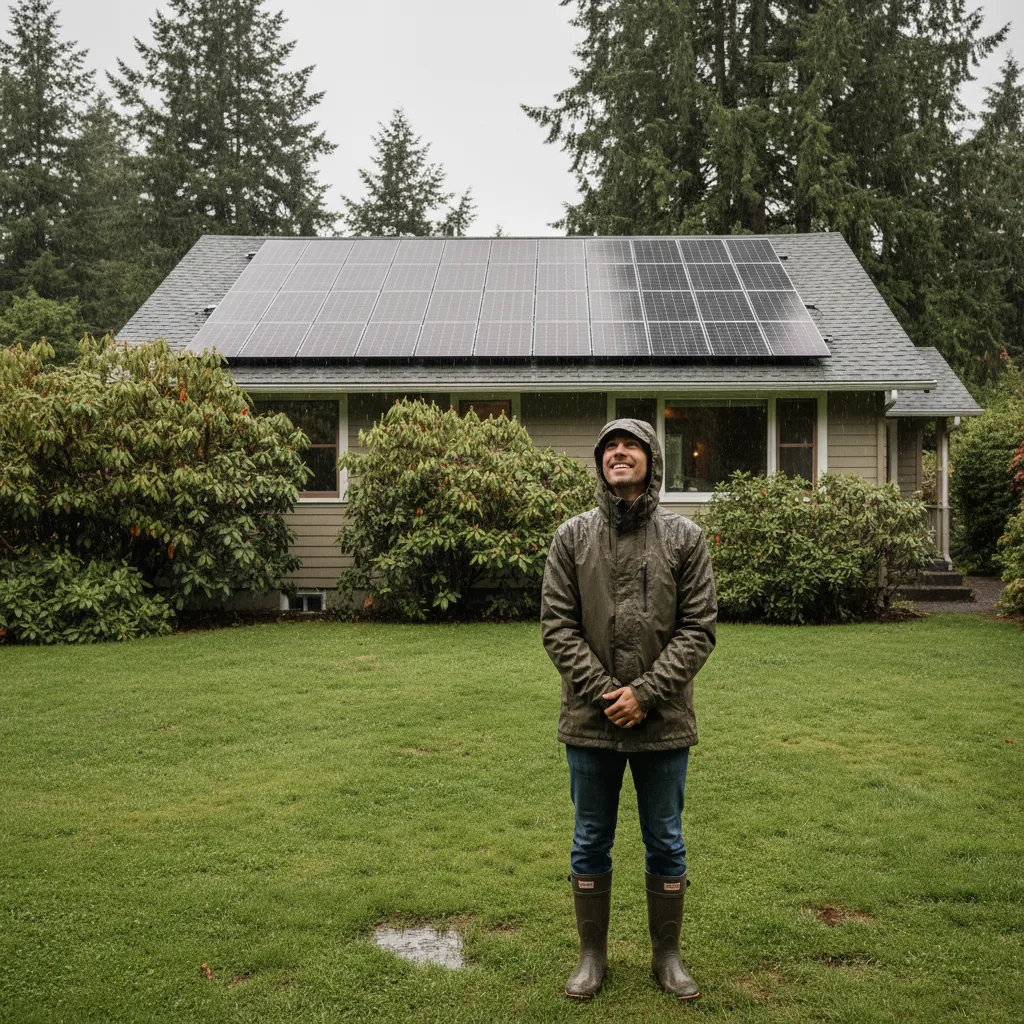
Ultimately, finding the best solar panels for Pacific Northwest homeowners comes down to picking technology that doesn’t mind the dark. By choosing TOPCon or HJT panels, you are future-proofing your home against rising energy costs and ensuring that even on the gloomiest Tuesday in January, your home is still contributing to a greener future.
Frequently Asked Questions
Are solar panels worth it in Seattle with all the cloudy days?
Yes. While Seattle gets less sun than LA, modern TOPCon and HJT panels are designed to capture diffuse light. When combined with Washington’s sales tax exemption and net metering, the ROI typically lands between 11 and 14 years, which is excellent for a 30-year asset.
What is the best solar panel brand for rainy Pacific Northwest weather?
Jinko Solar and REC are currently the top contenders. REC is specifically praised for its HJT technology and robust frames that handle heavy moisture and snow loads better than budget brands.
How much do solar panels cost to install in Washington State in 2026?
A typical 8kW system in Washington costs between $22,000 and $26,000 before the 30% federal tax credit. Because there is no sales tax on solar in WA, the out-of-pocket cost is significantly lower than in many other states.
Does Oregon have better solar incentives than Washington State?
Oregon has a higher potential rebate through the Solar + Storage program (up to $5,000), but Washington’s 100% sales tax exemption is more consistent and easier to claim. Both states are among the best in the US for solar policy.
How many solar panels do I need for a home in Portland Oregon?
The average Portland home uses about 10,000 kWh per year. To cover 100% of this usage, you would typically need a system size of 9kW to 10kW, which equates to about 22-25 high-efficiency panels (430W each).

Written by Mangaleswaran
Mangaleswaran is a dedicated sustainable living expert and the founder of EcoDweller. With a deep passion for renewable energy, he specializes in simplifying complex green technologies—like solar power and home efficiency—for the modern homeowner. His mission is to empower individuals to reduce their environmental impact while building more cost-effective, eco-friendly homes for the future.
Follow on Facebook