
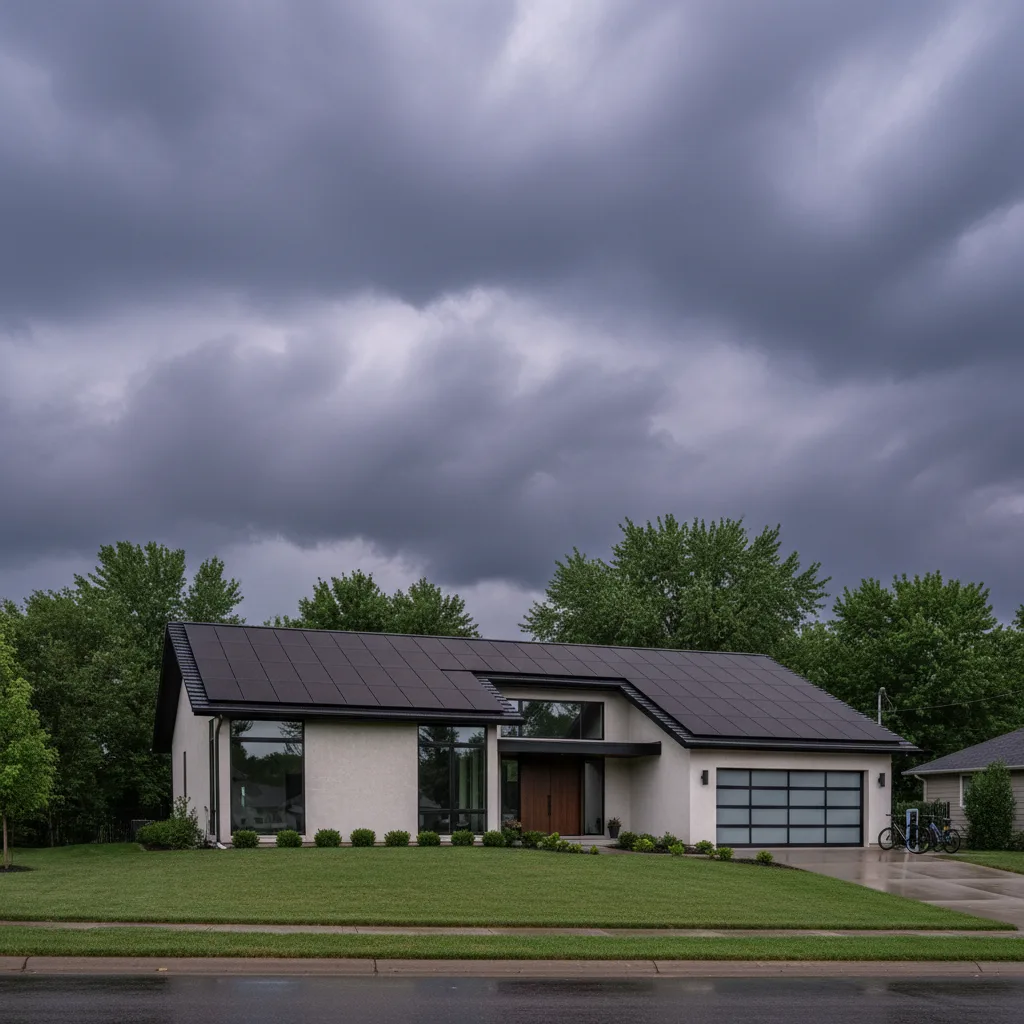
Living in the Pacific Northwest, I’ve grown accustomed to what we locals call ‘The Big Grey.’ For years, my neighbors and I lived under the assumption that solar power was a luxury reserved for the sun-drenched plains of Arizona or the beaches of Florida. When I first installed my standard PERC (Passivated Emitter and Rear Cell) array back in 2018, I watched the production meters plummet every time a storm rolled in from the coast. But the industry has moved fast. Lately, the buzz has shifted toward a new contender. When evaluating TOPCon vs PERC solar panels, overcast skies are no longer just an edge case for lab scientists; they are the deciding factor for homeowners in New York, Seattle, and Toronto.
Table of Contents
- ●The Technical Shift: Why TOPCon is Taking Over
- ●How Clouds Affect Solar Generation
- ●Deep Dive: TOPCon vs PERC Efficiency in Overcast Skies
- ●Comparison Table: TOPCon vs PERC
- ●Real Example: The 5kW Overcast Test
- ●Interactive: Cloudy Day Yield Estimator
- ●Common Mistakes When Buying for Cloudy Climates
- ●Pro Tips for Maximum Overcast Output
- ●Truth & Warning: Don’t Expect Miracles
- ●The Financial Breakdown: Is the TOPCon Premium Worth It?
- ●FAQ: TOPCon vs PERC Solar Panels Overcast Skies
- ●1. Does TOPCon actually work at night?
- ●2. Is TOPCon better than HJT (Heterojunction)?
- ●3. Can I mix TOPCon and PERC panels on the same roof?
- ●4. How do I know if a panel is TOPCon?
- ●5. Is PERC going to become obsolete?
- ●Final Verdict: Choosing Your Technology
Key Takeaways: Cloudy Day Performance
- Low-Light Superiority: TOPCon panels generally offer 3-5% better efficiency in low-light conditions compared to traditional PERC.
- Spectral Sensitivity: TOPCon technology captures a wider spectrum of light, which is crucial when direct sunlight is diffused by clouds.
- Long-Term Value: While TOPCon has a slightly higher upfront cost, its lower degradation rate often leads to a better 25-year ROI.
- Temperature Resilience: TOPCon panels maintain higher efficiency as temperatures rise, though this is less of a factor on overcast, cool days.
The Technical Shift: Why TOPCon is Taking Over
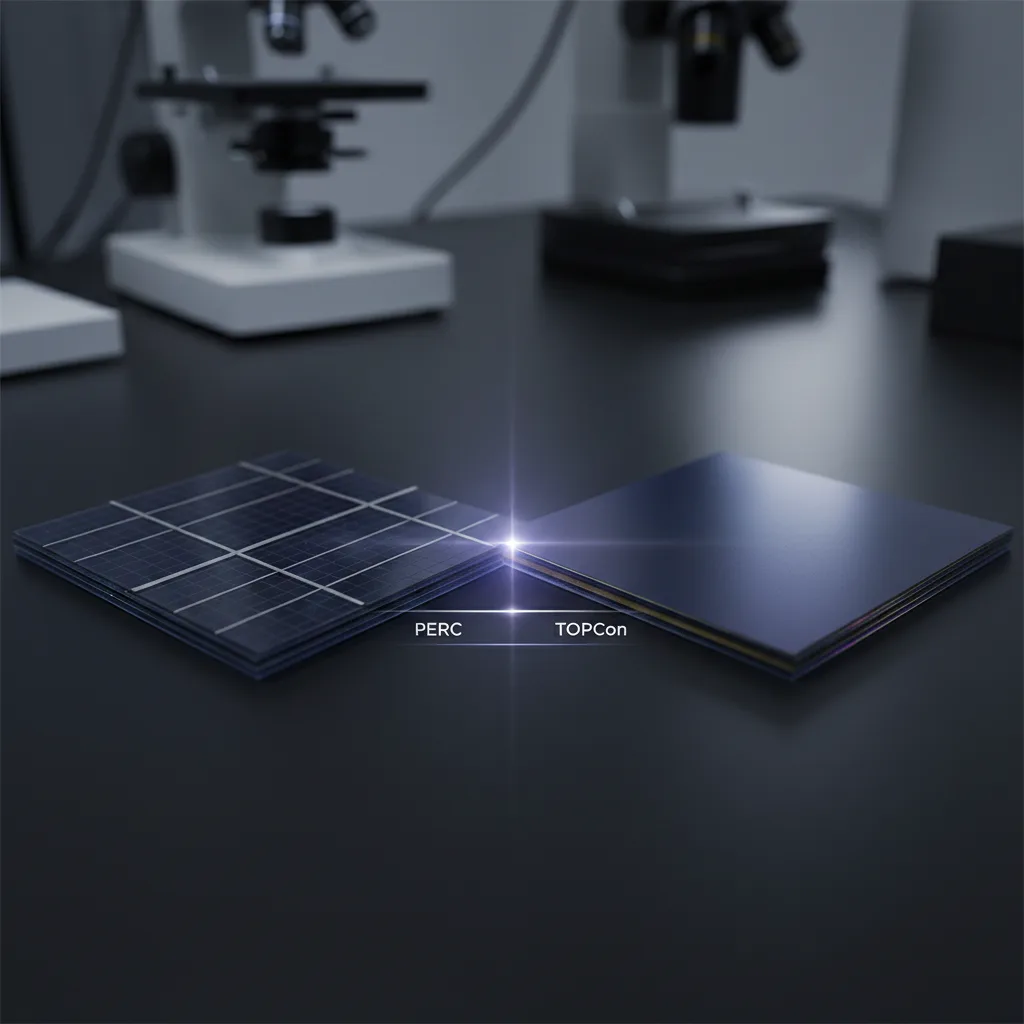
To understand the winner in the TOPCon versus PERC debate under cloudy conditions, we have to look at how these cells are built. PERC technology dominated the market for the last decade by adding a passivation layer to the back of the solar cell. This layer reflects light back into the cell for a second chance at being absorbed. It was a game-changer, pushing efficiencies past 20%.
However, TOPCon (Tunnel Oxide Passivated Contact) is the next evolution. It uses an ultra-thin tunnel oxide layer and a doped polycrystalline silicon layer. This setup does something PERC can’t: it significantly reduces ‘recombination’—where electrons lose their energy before they can be harvested as electricity. According to research from the Fraunhofer Institute for Solar Energy Systems, this architectural change allows for higher open-circuit voltage, which is exactly what you need when the sun is hiding behind a thick layer of cumulus clouds.
When I upgraded a small section of my roof to TOPCon last year, the difference was immediate during our rainy October. While my PERC panels were putting out a trickle, the TOPCon modules were noticeably more active. If you are curious about the broader costs of these technologies, check out our guide on Solar Panel Installation Cost in 2026.
How Clouds Affect Solar Generation
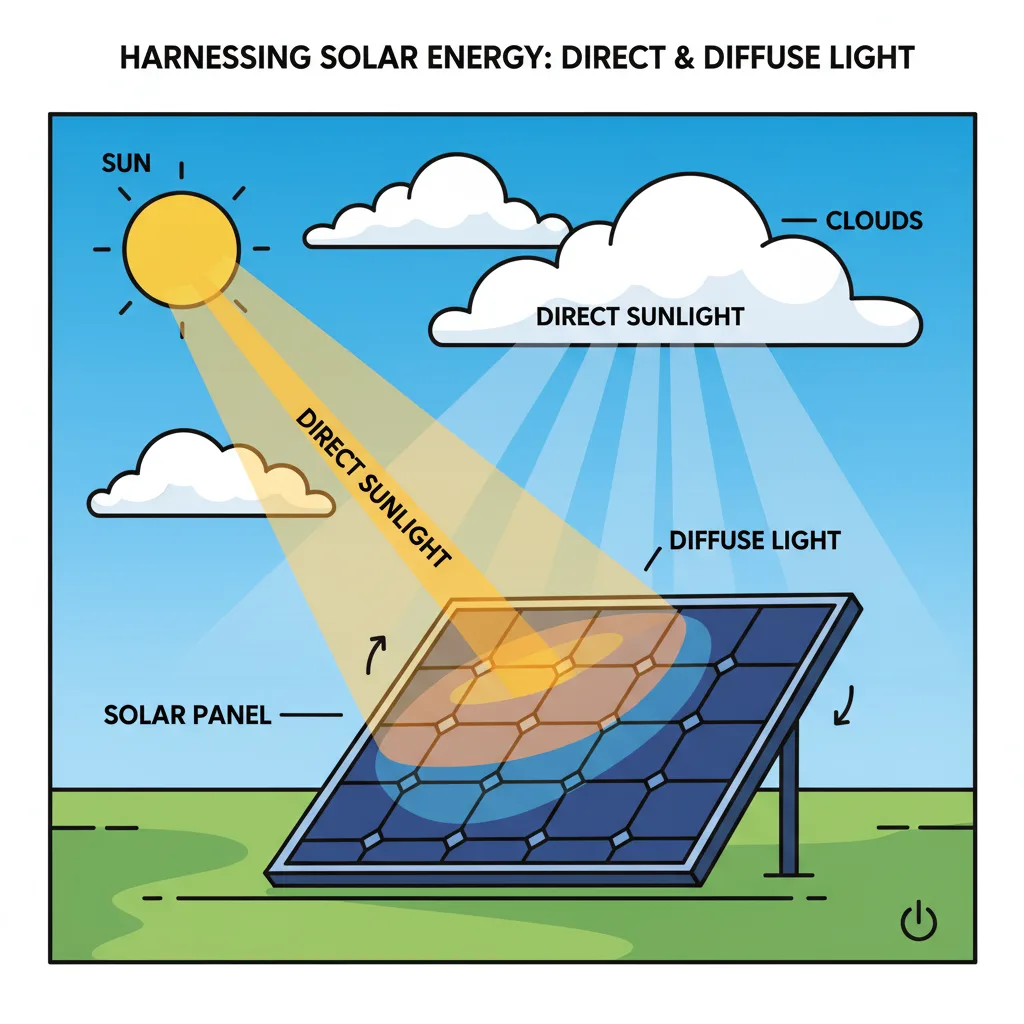
- Diffuse Radiation: Clouds scatter sunlight, turning direct beams into ‘diffuse’ light that comes from all angles.
- Spectral Shift: Overcast skies shift the light spectrum toward shorter, bluer wavelengths.
- Lower Irradiance: Instead of 1,000 W/m², you might only get 100-300 W/m² on a dark day.
- Cell Activation: Panels need a minimum threshold of light to ‘wake up’ and start generating voltage.
Deep Dive: TOPCon vs PERC Efficiency in Overcast Skies
In the world of PV (photovoltaics), efficiency isn’t just about the peak output on a summer noon. It’s about the ‘yield’—the total energy produced over a year. This is where TOPCon shines in regions with high cloud cover. The N-type silicon used in TOPCon is inherently more resistant to impurities and has a better response to the blue-heavy light found during overcast conditions.
Data from NREL (National Renewable Energy Laboratory) suggests that N-type cells like TOPCon have a superior spectral response. Essentially, they are ‘tuned’ to catch more of the light that actually makes it through the clouds. When we compare how these two technologies perform in low-light environments, the TOPCon panels often start producing earlier in the morning and stop later in the evening, squeezing every bit of available energy out of the twilight hours.
Internal Link: The Impact of Weather
Want to see how your specific zip code handles the weather? Visit The Ultimate 2026 Guide to Solar Panel Efficiency in Cloudy Weather for a deep dive into climatic impacts on ROI.
Comparison Table: TOPCon vs PERC
| Feature | PERC (P-Type) | TOPCon (N-Type) |
|---|---|---|
| Avg. Efficiency | 20% – 21.5% | 22% – 24.5% |
| Low-Light Performance | Standard | Superior (Up to 5% higher) |
| Degradation (Year 1) | ~2.0% | ~1.0% |
| Annual Degradation | 0.45% – 0.55% | 0.40% |
| Temperature Coeff. | -0.35% / °C | -0.30% / °C |
Real Example: The 5kW Overcast Test
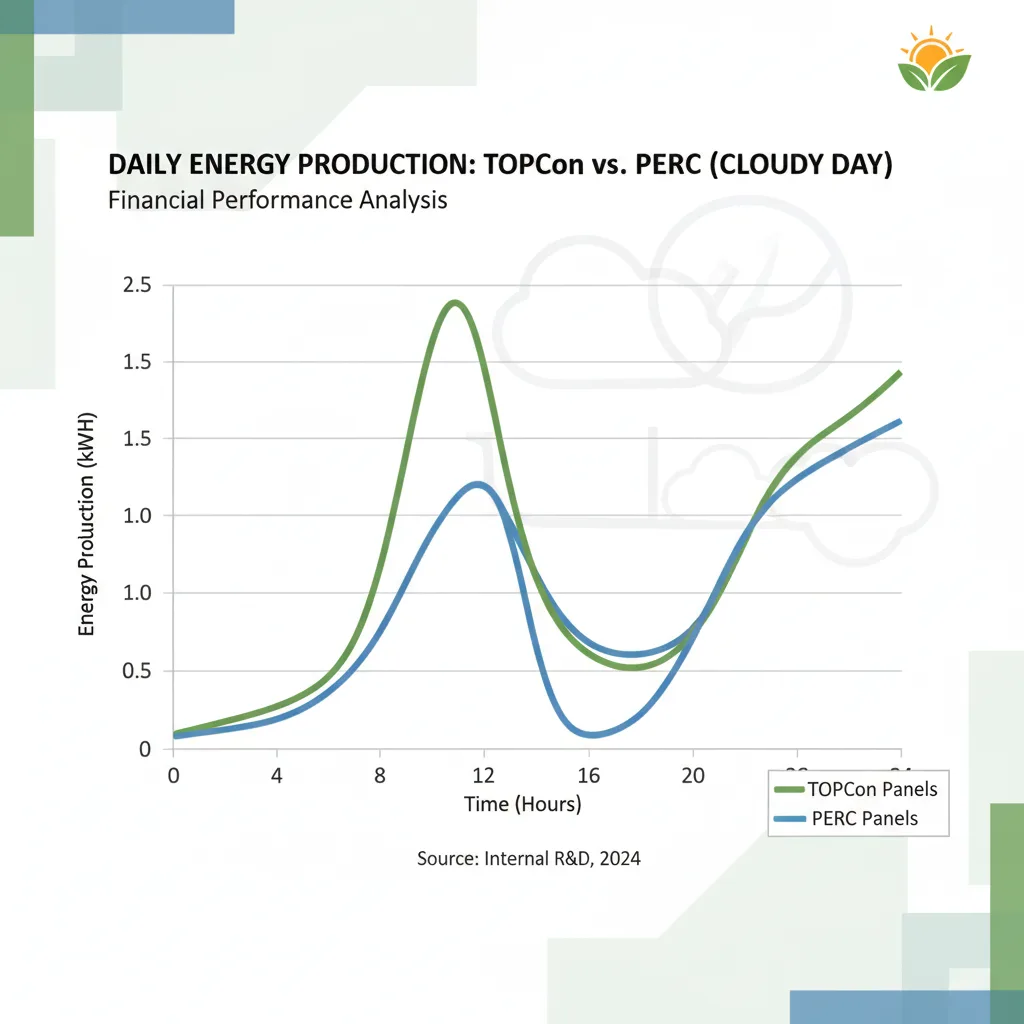
Let’s look at some real-world numbers. Imagine two 5kW systems installed in a city like Vancouver or Buffalo, where overcast skies are the norm. We simulated the annual output based on typical meteorological year data from Energy.gov.
- System A (PERC): 5,000 Watts. Annual Yield: ~5,200 kWh. Average daily yield on a cloudy day: 6-8 kWh.
- System B (TOPCon): 5,000 Watts. Annual Yield: ~5,650 kWh. Average daily yield on a cloudy day: 9.5-11 kWh.
The difference might seem small per day, but over 365 days, that extra 450 kWh represents a significant chunk of change. If you pay $0.15/kWh, that is an extra $67.50 in savings every year just for choosing the right technology. Over 25 years, that’s nearly $1,700—and that’s assuming electricity prices don’t rise. If you’re wondering if this makes the initial investment worth it, take a look at our Residential Solar Power ROI guide.
Interactive: Cloudy Day Yield Estimator
Select your system size and technology to see estimated daily generation under heavy overcast skies.
Common Mistakes When Buying for Cloudy Climates
It’s easy to get lost in the marketing jargon. When buyers start comparing cloudy weather performance metrics between N-type and P-type panels, they often fall into a few traps. First, don’t buy based on the nameplate wattage alone. A 400W PERC panel and a 400W TOPCon panel are both 400W under Standard Test Conditions (STC), but they perform very differently in the ‘real world’ of shade and clouds.
- Ignoring Temperature Coefficients: Even in cloudy weather, panels can get warm. TOPCon has a lower coefficient, meaning it loses less power as it heats up.
- Overlooking LID: Light Induced Degradation hits PERC panels harder in their first year. TOPCon’s N-type substrate is almost immune to LID.
- Underestimating Bifacial Gains: Many TOPCon panels are bifacial (they catch light from both sides). On overcast days, the light is coming from everywhere (albedo), making bifaciality even more effective.
- Buying ‘Cheap’ Panels: Saving $500 on a 10kW system by choosing older PERC tech can cost you $3,000 in lost production over 20 years.
If you’re planning a DIY install to save on costs, make sure you read our DIY Solar Panel Installation Guide to avoid structural errors that could negate your efficiency gains.
Pro Tips for Maximum Overcast Output
Beyond just picking the right cell technology, how you set up your system matters. If you’ve decided that TOPCon is the winner in the cloudy climate solar debate for your home, consider these expert tweaks to squeeze out every drop of energy.
- Use Microinverters: On cloudy days, cloud movement can create partial shading. Microinverters allow each panel to work independently, whereas string inverters can drag the whole system down if one panel is obscured.
- Optimize Tilt: In northern latitudes with frequent clouds, a slightly flatter tilt can actually help capture more ‘diffuse’ light from the entire sky vault rather than just direct southern light.
- Keep Them Clean: It sounds simple, but dust and pollen combined with light mist can create a film that blocks the blue light TOPCon is so good at catching.
- Check the Albedo: If you have a flat roof, using a light-colored or reflective roof membrane can boost the output of bifacial TOPCon panels by up to 15%.
Truth & Warning: Don’t Expect Miracles
While the low-light generation data clearly favors TOPCon, I have to be the bearer of some ‘green’ reality. Solar panels, regardless of how advanced they are, still need photons. A TOPCon panel will not produce 100% of its capacity in a thunderstorm. It is simply better at harvesting the 10-20% of light that is available compared to PERC.
Warning: Marketing vs. Reality
- Some manufacturers claim ‘perfect’ performance in shade. This is false.
- Always verify third-party testing data (like PVEL scores) before buying.
- Efficiency gains are marginal (3-7%), not revolutionary (50%+).
For those looking for more ways to make their home energy-independent, even when the sun isn’t shining, I highly recommend looking into Heat Pump Water Heaters to reduce your overall load, making your solar yield go much further.
The Financial Breakdown: Is the TOPCon Premium Worth It?
As of late 2025 and heading into 2026, the price gap between PERC and TOPCon has narrowed significantly. According to market analysis from PV Tech, the manufacturing cost for TOPCon is now only about 5-10% higher than PERC. For a typical residential 8kW system, you might be looking at an extra $400 to $800 in module costs.
Is it worth it? Let’s look at the math:
- Extra Cost: $600
- Extra Generation: ~600 kWh/year (in a cloudy climate)
- Annual Savings: $90 (at $0.15/kWh)
- Payback on Premium: ~6.6 years
Since solar panels are designed to last 25 to 30 years, that leaves you with nearly 20 years of ‘pure’ extra profit. Plus, TOPCon’s better degradation rates mean you’ll have a much more powerful system in year 20 than you would with PERC. For more on maximizing your financial returns, read our guide on Top Green Investment Opportunities.
FAQ: TOPCon vs PERC Solar Panels Overcast Skies
1. Does TOPCon actually work at night?
No. No solar panel works at night. However, TOPCon panels are more sensitive to ‘low-light’ conditions, meaning they can start producing slightly earlier in the dawn and later into the dusk than PERC panels.
2. Is TOPCon better than HJT (Heterojunction)?
HJT is technically even more efficient than TOPCon but often much more expensive. For most homeowners, TOPCon provides the ‘sweet spot’ between cost and high-performance cloudy day generation.
3. Can I mix TOPCon and PERC panels on the same roof?
It is not recommended. They have different electrical characteristics (voltage and current). If you do mix them, you must use power optimizers or microinverters to ensure the PERC panels don’t drag down the performance of your TOPCon panels.
4. How do I know if a panel is TOPCon?
Look at the datasheet. It will usually specify ‘N-Type TOPCon’ or mention ‘Tunnel Oxide Passivated Contact’ technology. Major brands like Jinko Solar, Trina Solar, and Canadian Solar have shifted heavily into TOPCon.
5. Is PERC going to become obsolete?
Yes, eventually. Most major manufacturers are transitioning their production lines to TOPCon because it offers a higher theoretical efficiency limit and better real-world performance for a similar manufacturing cost.
Final Verdict: Choosing Your Technology
If you live in a region that sees more clouds than sunshine, there is a clear winner when looking at TOPCon vs PERC solar panels: overcast skies are where TOPCon truly shines. The combination of N-type silicon, better spectral response, and lower degradation makes it the superior choice for maximizing energy harvest in less-than-ideal conditions.
Don’t let a few clouds dampen your sustainable dreams. By investing in the right tech today, you ensure a greener, more affordable tomorrow for your household. Ready to take the next step in your solar journey? I recommend using our Solar Panel Payback Period Calculator Tool to see exactly how these efficiency gains impact your wallet.
How Many Watts Does a Solar Panel Produce on a Cloudy Day?

Written by Mangaleswaran
Mangaleswaran is a dedicated sustainable living expert and the founder of EcoDweller. With a deep passion for renewable energy, he specializes in simplifying complex green technologies—like solar power and home efficiency—for the modern homeowner. His mission is to empower individuals to reduce their environmental impact while building more cost-effective, eco-friendly homes for the future.
Follow on Facebook