
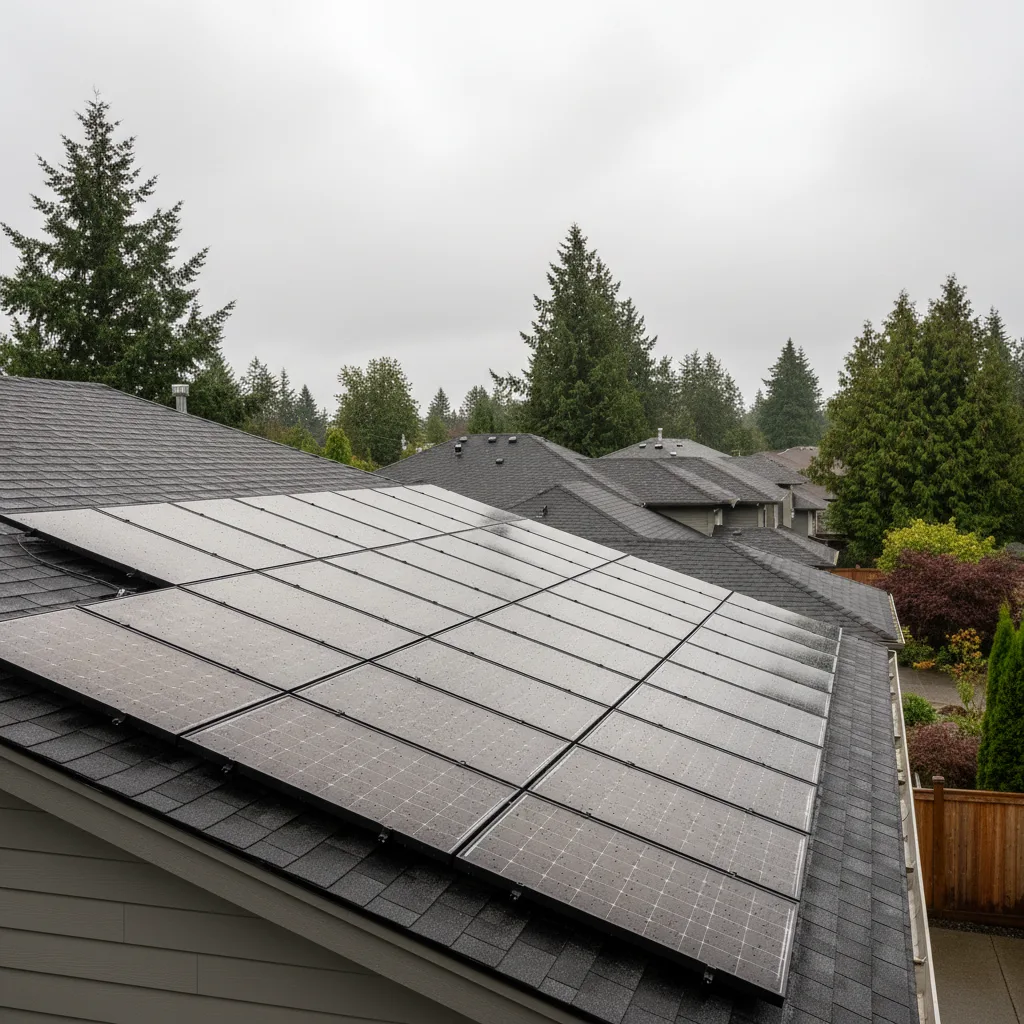
On a cloudy day, a standard 400W solar panel typically produces between 40 and 120 watts—roughly 10% to 30% of its rated capacity. While many homeowners worry that their investment goes dormant when the sun hides behind the clouds, the reality is much more nuanced. Output depends on cloud thickness, panel technology, and your specific geographic location. Modern TOPCon and HJT panels consistently outperform older PERC models in low-light conditions, ensuring your home stays powered even during a gray week in the Pacific Northwest.
Table of Contents
- ●Key Takeaways: Cloudy Day Solar Facts
- ●How solar panels actually work on cloudy days
- ●Real watt output by cloud cover type (data table)
- ●TOPCon vs HJT vs PERC: which loses the least on overcast days?
- ●Does location matter? Seattle vs Florida on a cloudy day
- ●Interactive Cloudy Day Solar Calculator
- ●How to calculate your expected output on low-light days
- ●5 ways to maximize solar output when it is overcast
- ●Real Example: The Seattle Case Study
- ●Common Mistakes with Low-Light Solar
- ●The Warning: Why “Watts” Isn’t the Only Metric
- ●FAQ: Frequently Asked Questions about Cloudy Day Solar
- ●1. Do solar panels work on completely overcast days?
- ●2. What percentage of power do solar panels produce on a cloudy day?
- ●3. Which solar panel type works best in low light?
- ●4. Can I still charge a battery on a cloudy day with solar panels?
- ●5. Does rain clean solar panels and improve output?
- ●Conclusion: Is Solar Worth It in Cloudy Climates?
Key Takeaways: Cloudy Day Solar Facts
- Percentage Yield: Most panels retain 10% to 25% of their peak capacity during heavy cloud cover.
- Diffuse Light: Solar panels use both direct and diffuse light; they do not need direct sunlight to generate electricity.
- Technology Matters: TOPCon panels outperform PERC in diffuse light due to better spectral response.
- Temperature Bonus: Clouds often bring cooler temperatures, which can slightly improve panel efficiency compared to scorching hot, sunny days.
- The Silver Lining: The “Edge-of-Cloud” effect can actually cause temporary spikes above rated wattage.
How solar panels actually work on cloudy days
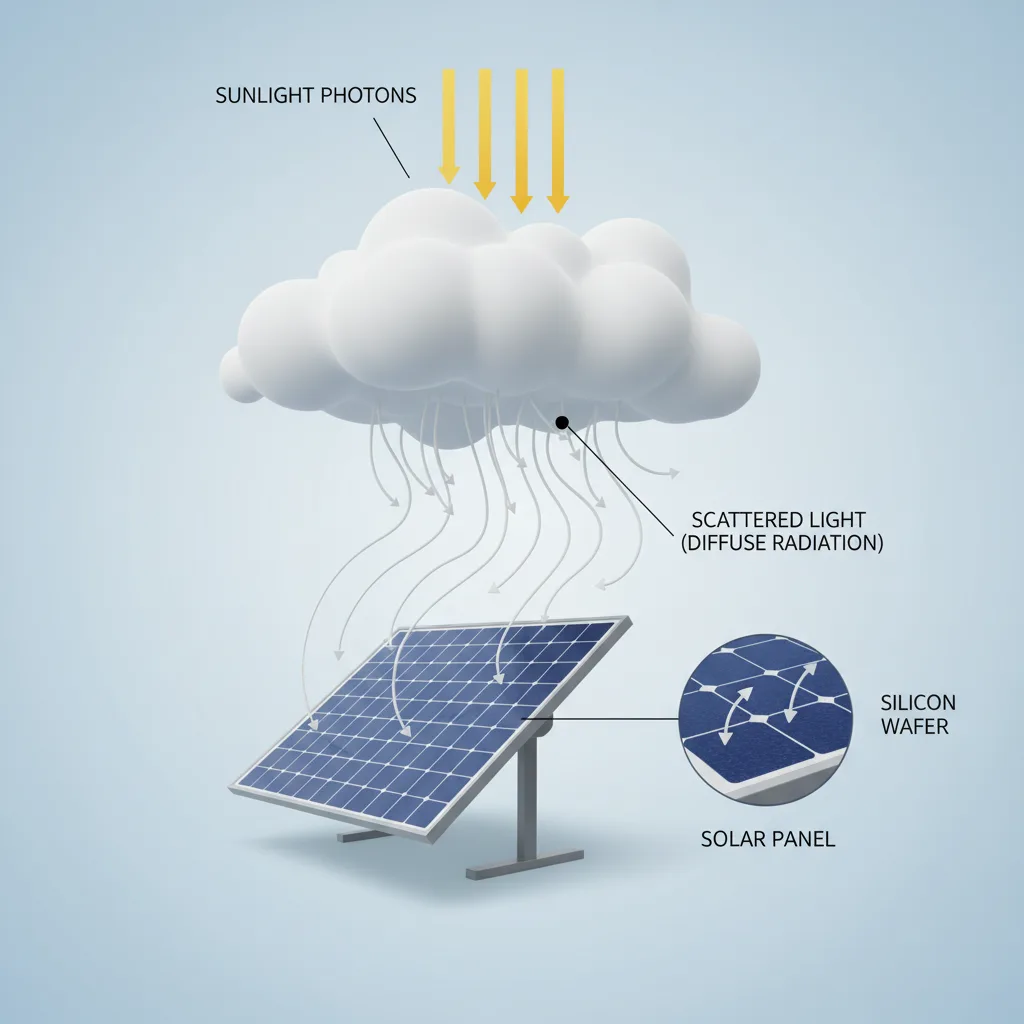
The science of solar energy doesn’t stop just because the sky turns grey. It is a common misconception that solar cells require the “heat” of the sun or a clear line of sight to the solar disk. In reality, photovoltaic (PV) cells respond to photons across a specific spectrum of light.
- Direct vs. Diffuse Radiation: On a sunny day, panels receive direct radiation. On a cloudy day, they receive diffuse radiation—light that has been scattered by water molecules and particles in the atmosphere.
- Visible vs. Infrared: Even when visible light is blocked, some infrared and ultraviolet waves still penetrate the cloud layer, allowing the PV cells to continue the electron flow.
- Electron Excitation: As long as photons hit the silicon wafer with enough energy to displace an electron, electricity is generated.
- Cloud Density: A thin “high-altitude” cloud layer might only drop production by 10%, while thick, dark storm clouds can reduce it by 90%.
Real watt output by cloud cover type (data table)
To answer the common question, “how many watts does a solar panel produce on a cloudy day?” we have to look at the density of the sky. A 400W panel is the current industry standard for residential installations in the US and Canada. Below is a breakdown of what you can expect based on real-world testing from the National Renewable Energy Laboratory (NREL).
| Sky Condition | Typical Efficiency | Output (400W Panel) |
|---|---|---|
| Full Sun | 100% | 380W – 400W |
| Light/High Clouds | 50% – 80% | 200W – 320W |
| Broken Clouds | 25% – 50% | 100W – 200W |
| Heavy Overcast | 10% – 25% | 40W – 100W |
| Dark Stormy Sky | 5% – 10% | 20W – 40W |
- Consistency: Even at 40W, a 20-panel array is still producing 800W, which is enough to run most of your home’s LED lighting and basic electronics.
- Bifacial Advantage: If you use bifacial panels in cloudy climates, you can gain an extra 5-15% by capturing light reflected off the ground.
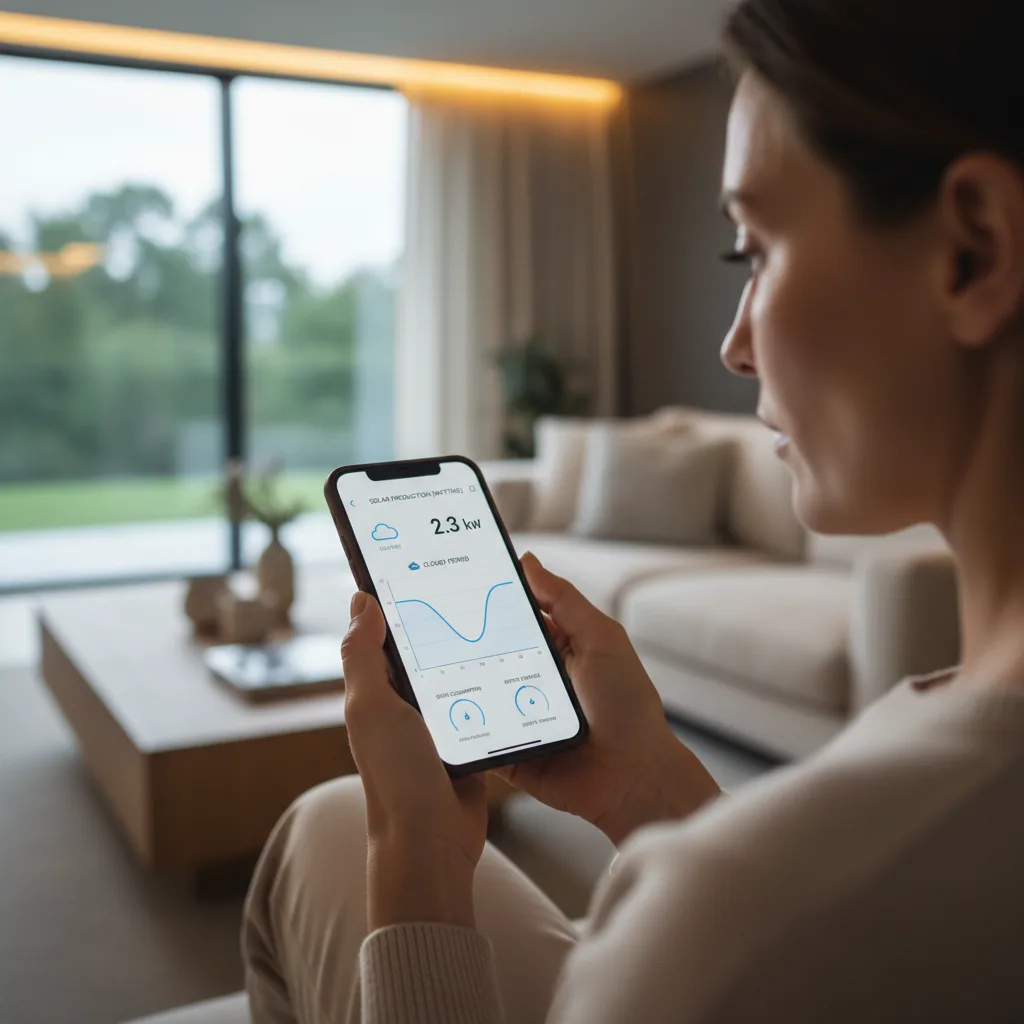
- Monitoring: Use a high-quality inverter app to track these dips in real-time.
- Energy Storage: This is why batteries are critical—they bridge the gap when output falls below your home’s baseline demand.
TOPCon vs HJT vs PERC: which loses the least on overcast days?
Not all silicon is created equal. If you live in an area with frequent cloud cover, such as Seattle, Vancouver, or the Great Lakes region, the internal chemistry of your panel is more important than its peak wattage rating. Research from Fraunhofer ISE shows that N-type cells are significantly superior in low-light environments.
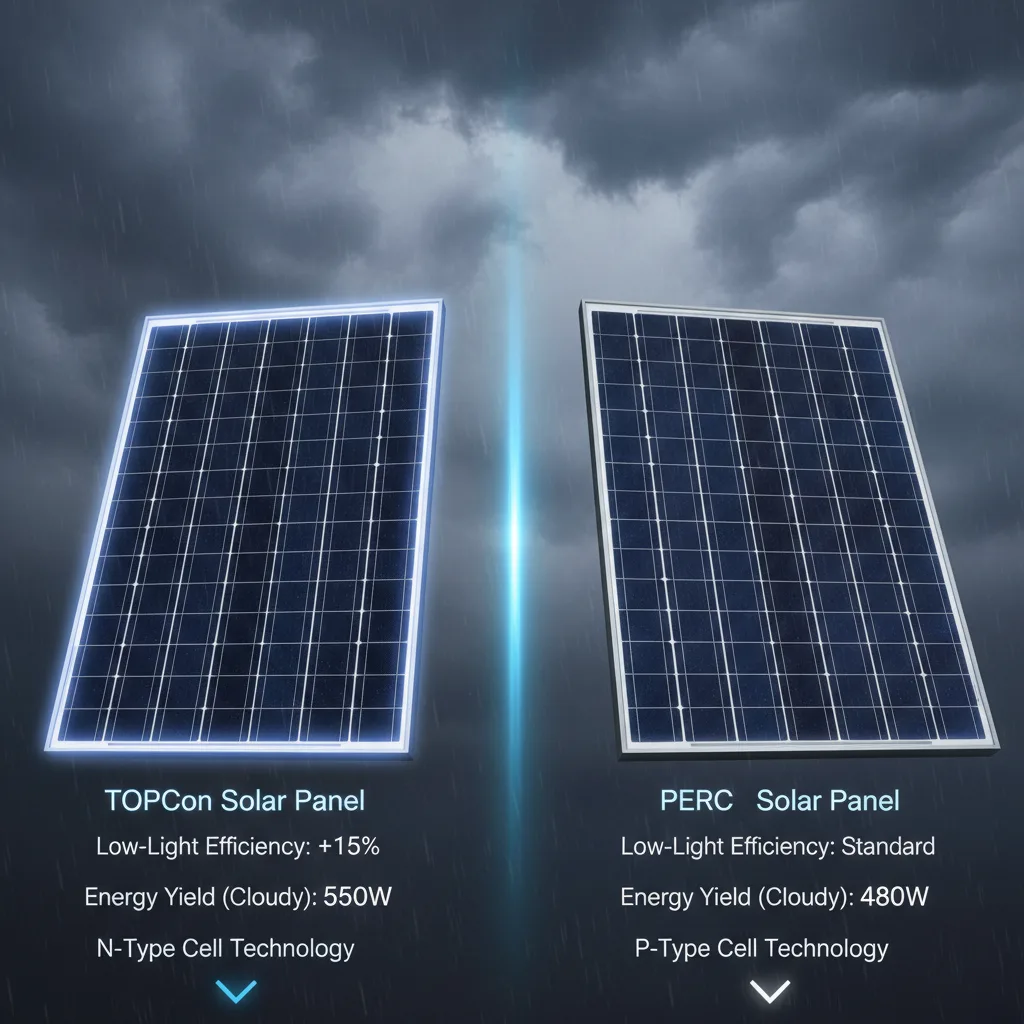
- PERC (Passivated Emitter and Rear Cell): The “old reliable” of the last decade. It’s affordable but suffers most in low light. Once photons drop below a certain energy threshold, PERC efficiency plummets.
- TOPCon (Tunnel Oxide Passivated Contact): This is the 2026 industry gold standard. It has a better spectral response in the blue and ultraviolet range, meaning it stays “active” longer during the dawn, dusk, and cloudy periods.
- HJT (Heterojunction Technology): HJT combines crystalline silicon with amorphous silicon. It is the king of low-light performance. It has the lowest temperature coefficient and the best response to diffuse light.
- Spectral Sensitivity: Modern N-type cells can convert a wider range of the light spectrum into electricity compared to P-type cells.
If you’re planning a new installation, check out our guide on TOPCon vs PERC solar panels in overcast skies to see the long-term ROI difference. Choosing the right tech can mean 10% more annual energy yield in cloudy states.
Does location matter? Seattle vs Florida on a cloudy day
Geography influences the quality of the clouds you deal with. A cloudy day in Miami is often a high-humidity, thin-cloud event, whereas a cloudy day in Seattle or Toronto might involve thick, multi-layered stratocumulus clouds. Understanding your local “Insolation Value” is key.
- Latitude Impact: Higher latitudes (like Canada) have more atmosphere for light to travel through, making diffuse light performance even more critical.
- Albedo Effect: In northern regions, snow on the ground can reflect light back onto the panels, often doubling the production on a bright but cloudy winter day.
- Microclimates: Coastal areas might have morning fog that burns off, while inland valleys might trap low-level clouds all day.
- Seasonal Variation: A cloudy day in June provides more watts than a cloudy day in December because the sun stays in the sky for 15 hours versus 9.
For those living in the Pacific Northwest, investing in the best panels for overcast Pacific Northwest homes is the difference between a 7-year and 12-year payback period.
Interactive Cloudy Day Solar Calculator
Use this tool to estimate how many watts your system will produce based on current sky conditions. This uses standard 2026 efficiency metrics for residential monocrystalline panels.
- Disclaimer: This is an estimate. Real-world wiring losses and inverter efficiency (typically 3-5%) are not included.
- System Total: Multiply the result by the number of panels in your array for your total system production.
- Time of Day: This assumes peak sun hours (11 AM – 2 PM). Output will be lower in the morning or evening.
How to calculate your expected output on low-light days
If you prefer to do the math manually, you can use a simple formula to forecast your energy production. This is helpful for off-grid planning where every watt-hour counts. You can cross-reference your findings with the Solar Panel Efficiency Cloudy Weather Tool for even more precision.
- The Formula: (Panel Wattage) × (Cloud Efficiency Factor) × (Inverter Efficiency) = Real-time Watts.
- Cloud Efficiency Factors: Use 0.25 for standard cloudy days and 0.10 for rainy, dark days.
- Daily Yield: To find Wh (Watt-hours), multiply the result by the number of daylight hours.
- Degradation: Remember that panels lose about 0.5% efficiency per year, so a 10-year-old panel will produce slightly less.
5 ways to maximize solar output when it is overcast
You can’t control the weather, but you can control how your system reacts to it. Maximizing your solar panels’ output in low-light conditions requires a combination of hardware choices and maintenance habits.
- 1. Optimize Tilt Angle: In cloudy regions, a flatter tilt can sometimes capture more diffuse light from the entire dome of the sky, whereas a steep tilt is better for direct southern sun.
- 2. Use Microinverters: In a string inverter system, one cloudy panel can drag down the performance of the whole row. Microinverters (like Enphase) allow each panel to work independently.
- 3. Keep Panels Clean: Dust and pollen might not seem like much, but when you’re already at 20% production, an extra 5% loss from dirt can be the difference between charging your battery and draining it.
- 4. Invest in High-Efficiency Inverters: Look for inverters with low “startup voltage.” This ensures your system starts producing as soon as the sun rises, even if it’s foggy.
- 5. Bifacial Panels with Reflective Surfaces: If you have a flat roof or ground mount, use white gravel or a white TPO roof membrane to reflect diffuse light onto the back of the panels.
Real Example: The Seattle Case Study
Let’s look at a real-world installation in Seattle, WA, during a typical overcast November day.
- System Size: 8.0 kW (20 panels of 400W each).
- Sky Condition: Thick stratus clouds, light drizzle.
- Expected Peak Output (Sun): 7,600W (accounting for losses).
- Actual Measured Output: 1,140W.
- Performance: 15% of rated capacity.
- Daily Total: Over 7 hours of daylight, the system produced 6.2 kWh. This was enough to cover the home’s refrigerator, internet, and standby loads for the entire day without touching the grid.
Common Mistakes with Low-Light Solar
Many homeowners make critical errors when evaluating solar for cloudy climates. Avoid these pitfalls to ensure you don’t overspend or undersize your system.
- Oversizing for the Worst Day: Don’t build a system to cover 100% of your needs on the darkest day of the year; it will be massive and expensive. Size for the annual average instead.
- Ignoring Shading: Cloudy days hide shadows. You might not realize a tree is blocking your panels until the sun finally comes out, potentially damaging your cells over time via “hot spots.”
- Buying P-Type Panels: In 2026, P-type PERC panels are cheap, but they are inefficient in low light. The few hundred dollars you save upfront will be lost in lower energy production over 25 years.
- Neglecting Maintenance: Assuming rain cleans your panels perfectly is a mistake. Heavy rain can actually leave “mud” spots or mineral deposits that hinder low-light absorption.
The Warning: Why “Watts” Isn’t the Only Metric
While most homeowners focus entirely on how much power their solar array generates during an overcast day, the voltage is equally important. Solar panels produce DC electricity. If the light is too low, the voltage might not be high enough to “wake up” your inverter. This means your panels could be producing 50 watts, but your house is getting zero because the inverter is sitting idle. Always check the “Start-up Voltage” on your inverter’s spec sheet—especially if you live in Canada or the Northern US.
FAQ: Frequently Asked Questions about Cloudy Day Solar
1. Do solar panels work on completely overcast days?
- Yes, they do. They utilize diffuse sunlight that penetrates through the cloud cover. Production is usually 10% to 25% of their capacity.
2. What percentage of power do solar panels produce on a cloudy day?
- Generally, you can expect 10-30% on a standard grey day. On very dark, stormy days, it can drop below 10%.
3. Which solar panel type works best in low light?
- N-type HJT (Heterojunction) and TOPCon panels are the best performers in low-light and cloudy conditions compared to traditional PERC panels.
4. Can I still charge a battery on a cloudy day with solar panels?
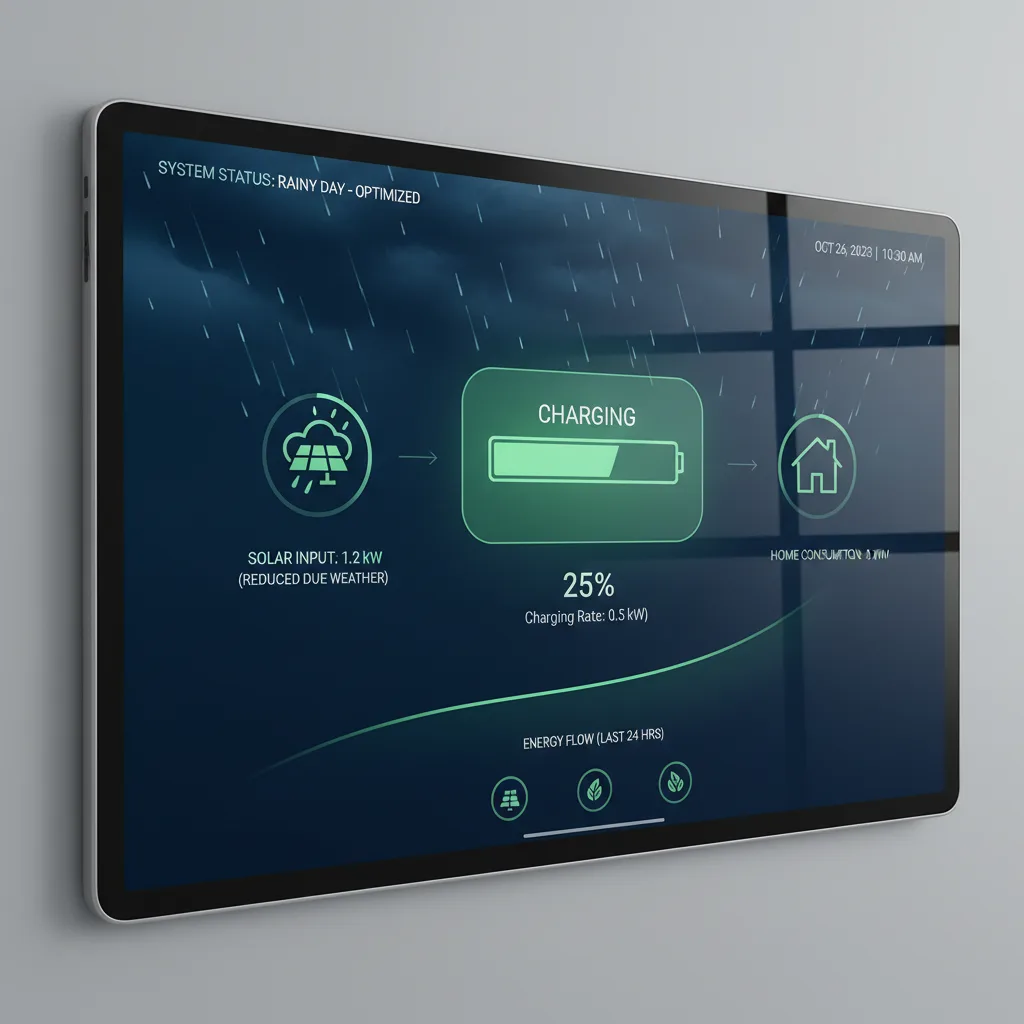
- Yes, but it will take much longer. If your system produces more than your home is currently consuming, the excess will still trickle into your battery.
5. Does rain clean solar panels and improve output?
- Light rain can help rinse off loose dust, but it doesn’t replace a manual cleaning. Rain can also leave streaks that slightly decrease efficiency once the sun returns.
Conclusion: Is Solar Worth It in Cloudy Climates?
The short answer is a resounding yes. While individual wattage drops on grey days, solar power is a long game. Even in cloudy cities like Seattle or Portland, solar systems pay for themselves because they continue to produce energy for 10-14 hours a day, regardless of sky conditions. By choosing the right technology, like TOPCon panels and microinverters, you can squeeze every possible watt out of the atmosphere. Don’t let a few clouds discourage you from energy independence—the numbers prove that the light is always there, even when you can’t see the sun.

Written by Mangaleswaran
Mangaleswaran is a dedicated sustainable living expert and the founder of EcoDweller. With a deep passion for renewable energy, he specializes in simplifying complex green technologies—like solar power and home efficiency—for the modern homeowner. His mission is to empower individuals to reduce their environmental impact while building more cost-effective, eco-friendly homes for the future.
Follow on Facebook